

What Is The Final Result Of Meiosis In A Human And Most Other Animals
How is the same procedure responsible for genetic recombination and multifariousness as well the crusade of aneuploidy? Agreement the steps of meiosis is essential to learning how errors occur.

Organisms that reproduce sexually are thought to have an advantage over organisms that reproduce asexually, because novel combinations of genes are possible in each generation. Furthermore, with few exceptions, each individual in a population of sexually reproducing organisms has a singled-out genetic composition. We have meiosis to thank for this variety.
Meiosis, from the Greek word meioun, meaning "to brand pocket-sized," refers to the specialized process by which germ cells split up to produce gametes. Because the chromosome number of a species remains the aforementioned from ane generation to the next, the chromosome number of germ cells must be reduced by half during meiosis. To accomplish this feat, meiosis, dissimilar mitosis, involves a unmarried round of DNA replication followed by ii rounds of cell division (Figure 1). Meiosis likewise differs from mitosis in that it involves a process known as recombination, during which chromosomes exchange segments with one some other. As a result, the gametes produced during meiosis are genetically unique.
Researchers' initial understanding of meiosis was based upon conscientious observations of chromosome behavior using light microscopes. Then, in the 1950s, electron microscopy provided scientists with a glimpse of the intricate structures formed when chromosomes recombine. More recently, researchers have been able to identify some of the molecular players in meiosis from biochemical analyses of meiotic chromosomes and from genetic studies of meiosis-specific mutants.
Meiosis Is a Highly Regulated Process
Meiosis represents a survival machinery for some simple eukaryotes such equally yeast. When conditions are favorable, yeast reproduce asexually by mitosis. When nutrients become limited, withal, yeast enter meiosis. The delivery to meiosis enhances the probability that the next generation will survive, because genetic recombination during meiosis generates four reproductive spores per cell, each of which has a novel genotype. The entry of yeast into meiosis is a highly regulated process that involves pregnant changes in gene transcription (Lopez-Maury et al., 2008). By analyzing yeast mutants that are unable to complete the various events of meiosis, investigators have been able to identify some of the molecules involved in this complex process. These controls have been strongly conserved during evolution, then such yeast experiments have provided valuable insight into meiosis in multicellular organisms besides.
In almost multicellular organisms, meiosis is restricted to germ cells that are ready aside in early development. The germ cells reside in specialized environments provided past the gonads, or sex organs. Inside the gonads, the germ cells proliferate past mitosis until they receive the correct signals to enter meiosis.
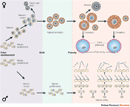
In mammals, the timing of meiosis differs greatly between males and females (Figure ii). Male germ cells, or spermatogonia, practise non enter meiosis until after puberty. Even then, only limited numbers of spermatogonia enter meiosis at whatever one fourth dimension, such that adult males retain a pool of actively dividing spermatogonia that acts as a stem jail cell population. On the other hand, meiosis occurs with quite different kinetics in mammalian females. Female person germ cells, or oogonia, stop dividing and enter meiosis within the fetal ovary. Those germ cells that enter meiosis get oocytes, the source of future eggs. Consequently, females are born with a finite number of oocytes arrested in the beginning meiotic prophase. Within the ovary, these oocytes grow inside follicle structures containing big numbers of back up cells. The oocytes will reenter meiosis only when they are ovulated in response to hormones. Human females, for example, are born with hundreds of thousands of oocytes that remain arrested in the first meiotic prophase for decades. Over time, the quality of the oocytes may deteriorate; indeed, researchers know that many oocytes die and disappear from ovaries in a procedure known as atresia.
Meiosis Consists of a Reduction Partitioning and an Equational Division
Two divisions, meiosis I and meiosis II, are required to produce gametes (Effigy iii). Meiosis I is a unique prison cell division that occurs but in germ cells; meiosis II is similar to a mitotic division. Earlier germ cells enter meiosis, they are generally diploid, significant that they have two homologous copies of each chromosome. Then, just before a germ cell enters meiosis, it duplicates its Deoxyribonucleic acid so that the cell contains four DNA copies distributed between ii pairs of homologous chromosomes.
Meiosis I
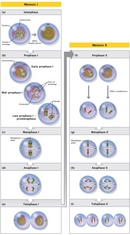
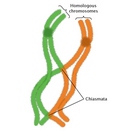
Compared to mitosis, which can take place in a matter of minutes, meiosis is a boring process, largely because of the time that the cell spends in prophase I. During prophase I, the pairs of homologous chromosomes come together to grade a tetrad or bivalent, which contains 4 chromatids. Recombination can occur betwixt any two chromatids inside this tetrad structure. (The recombination procedure is discussed in greater detail later in this article.) Crossovers between homologous chromatids can exist visualized in structures known as chiasmata, which appear late in prophase I (Figure 4). Chiasmata are essential for accurate meioses. In fact, cells that fail to course chiasmata may non be able to segregate their chromosomes properly during anaphase, thereby producing aneuploid gametes with abnormal numbers of chromosomes (Hassold & Chase, 2001).
At the stop of prometaphase I, meiotic cells enter metaphase I. Hither, in abrupt contrast to mitosis, pairs of homologous chromosomes line up opposite each other on the metaphase plate, with the kinetochores on sister chromatids facing the same pole. Pairs of sex chromosomes as well marshal on the metaphase plate. In homo males, the Y chromosome pairs and crosses over with the Ten chromosome. These crossovers are possible considering the 10 and Y chromosomes have modest regions of similarity nearly their tips. Crossover between these homologous regions ensures that the sexual practice chromosomes will segregate properly when the jail cell divides.
Adjacent, during anaphase I, the pairs of homologous chromosomes separate to unlike girl cells. Earlier the pairs tin separate, however, the crossovers between chromosomes must exist resolved and meiosis-specific cohesins must be released from the arms of the sister chromatids. Failure to separate the pairs of chromosomes to dissimilar girl cells is referred to as nondisjunction, and it is a major source of aneuploidy. Overall, aneuploidy appears to be a relatively frequent upshot in humans. In fact, the frequency of aneuploidy in humans has been estimated to be as high equally 10% to xxx%, and this frequency increases sharply with maternal age (Hassold & Hunt, 2001).
Meiosis Two
Following meiosis I, the daughter cells enter meiosis II without passing through interphase or replicating their DNA. Meiosis II resembles a mitotic division, except that the chromosome number has been reduced by half. Thus, the products of meiosis II are iv haploid cells that contain a single copy of each chromosome.
In mammals, the number of viable gametes obtained from meiosis differs between males and females. In males, four haploid spermatids of like size are produced from each spermatogonium. In females, nonetheless, the cytoplasmic divisions that occur during meiosis are very asymmetric. Fully grown oocytes within the ovary are already much larger than sperm, and the future egg retains almost of this volume as information technology passes through meiosis. As a consequence, merely one functional oocyte is obtained from each female meiosis (Figure two). The other iii haploid cells are pinched off from the oocyte as polar bodies that contain very footling cytoplasm.
Recombination Occurs During the Prolonged Prophase of Meiosis I

Prophase I is the longest and arguably well-nigh of import segment of meiosis, because recombination occurs during this interval. For many years, cytologists have divided prophase I into multiple segments, based upon the advent of the meiotic chromosomes. Thus, these scientists have described a leptotene (from the Greek for "thin threads") stage, which is followed sequentially by the zygotene (from the Greek for "paired threads"), pachytene (from the Greek for "thick threads"), and diplotene (from the Greek for "2 threads") phases. In recent years, cytology and genetics take come together so that researchers at present understand some of the molecular events responsible for the stunning rearrangements of chromatin observed during these phases.
Think that prophase I begins with the alignment of homologous chromosome pairs. Historically, alignment has been a difficult problem to approach experimentally, but new techniques for visualizing private chromosomes with fluorescent probes are providing insights into the process. Contempo experiments propose that chromosomes from some species have specific sequences that act every bit pairing centers for alignment. In some cases, alignment appears to brainstorm as early as interphase, when homologous chromosomes occupy the aforementioned territory inside the interphase nucleus (Effigy five). However, in other species, including yeast and humans, chromosomes exercise not pair with each other until double-stranded breaks (DSBs) announced in the DNA (Gerton & Hawley, 2005). The formation of DSBs is catalyzed by highly conserved proteins with topoisomerase activeness that resemble the Spo11 protein from yeast. Genetic studies have shown that Spo11 action is essential for meiosis in yeast, because spo11 mutants neglect to sporulate.
Post-obit the DSBs, one Deoxyribonucleic acid strand is trimmed back, leaving a iii′-overhang that "invades" a homologous sequence on another chromatid. As the invading strand is extended, a remarkable structure called synaptonemal circuitous (SC) develops around the paired homologues and holds them in close annals, or synapsis. The stability of the SC increases equally the invading strand first extends into the homologue and then is recaptured by the cleaved chromatid, forming double Holliday junctions. Investigators have been able to observe the process of SC germination with electron microscopy in meiocytes from the Allium plant (Figure 6). Bridges approximately 400 nanometers long begin to form betwixt the paired homologues following the DSB. Simply a fraction of these bridges will mature into SC; moreover, not all Holliday junctions volition mature into crossover sites. Recombination will thus occur at simply a few sites along each chromosome, and the products of the crossover volition become visible as chiasmata in diplotene after the SC has disappeared (Zickler & Kleckner, 1999).

Figure 6: Visualization of chromosomal bridges in Allium fistulosum and Allium cepa (constitute) meiocytes.
The sites of double-stranded interruption (DSB) dependent homologue interaction can be seen equally approximately 400 nm bridges between chromosome axes. These bridges, which probably contain a DSB that is already engaged in a nascent interaction with its partner Dna, occur in large numbers. Their germination depends on the RecA (recombination protein) homologues that are expressed in this species. In the next phase of homologue interaction, these nascent interactions are converted to stable strand-invasion events. This nucleates the formation of the synaptonemal complex (SC).
© 2005 Nature Publishing Group Gerton, J. L. & Hawley, R. Due south. Homologous chromosome interactions in meiosis: multifariousness amongst conservation. Nature Reviews Genetics half dozen, 481 (2005). All rights reserved. 
References and Recommended Reading
Gerton, J. Fifty., & Hawley, R. S. Homologous chromosome interactions in meiosis: Variety amidst conservation. Nature Reviews Genetics 6, 477–487 (2005) doi:10.1038/nrg1614 (link to article)
Hassold, T., & Chase, P. To err (meiotically) is human: The genesis of human aneuploidy. Nature Reviews Genetics two, 280–291 (2001) doi:10.1038/35066065 (link to article)
Lopez-Maury, L., Marguerat, Due south., & Bahler, J. Tuning gene expression to changing environments: From rapid responses to evolutionary accommodation. Nature Reviews Genetics ix, 583–593 (2008) doi:10.1038/nrg2398 (link to article)
Marston, A. L., & Amon, A. Meiosis: Cell-cycle controls shuffle and deal. Nature Reviews Molecular Cell Biology 5, 993–1008 (2004) doi:10.1038/nrm1526 (link to commodity)
Page, Southward. L., & Hawley, R. S. Chromosome choreography: The meiotic ballet. Science 301, 785–789 (2003)
Petes, T. D. Meiotic recombination hot spots and cold spots. Nature Reviews Genetics 2, 360–369 (2001) doi:10.1038/35072078 (link to article)
Zickler, D., & Kleckner, N. Meiotic chromosomes: Integrating structure and office. Almanac Review of Genetics 33, 603–754 (1999)
Source: http://www.nature.com/scitable/topicpage/meiosis-genetic-recombination-and-sexual-reproduction-210
Posted by: edgertongrous1984.blogspot.com
0 Response to "What Is The Final Result Of Meiosis In A Human And Most Other Animals"
Post a Comment