

How Does The Animal Kingdom Get Nutrients
Introduction to Animate being Diversity
137 Features of the Animal Kingdom
Learning Objectives
Past the finish of this section, you lot volition exist able to do the following:
- List the features that distinguish the kingdom Animalia from other kingdoms
- Explain the processes of beast reproduction and embryonic development
- Describe the roles that Hox genes play in development
Two different groups inside the Domain Eukaryota take produced circuitous multicellular organisms: The plants arose within the Archaeplastida, whereas the animals (and their close relatives, the fungi) arose inside the Opisthokonta. However, plants and animals not only have different life styles, they also have dissimilar cellular histories as eukaryotes. The opisthokonts share the possession of a single posterior flagellum in flagellated cells, e.yard., sperm cells.
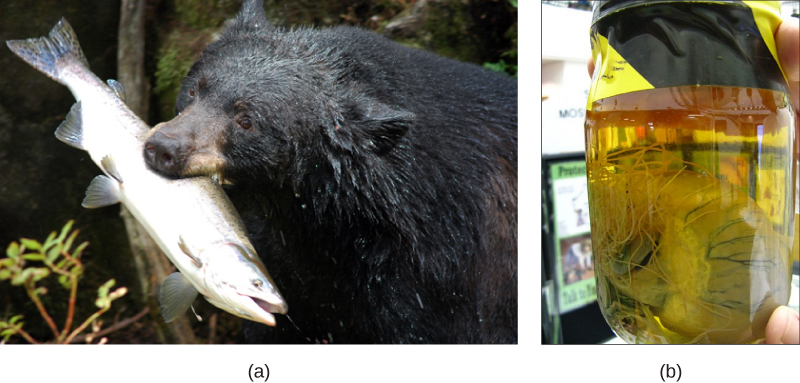
Near animals also share other features that distinguish them from organisms in other kingdoms. All animals crave a source of food and are therefore heterotrophic, ingesting other living or dead organisms. This feature distinguishes them from autotrophic organisms, such as nigh plants, which synthesize their own nutrients through photosynthesis. As heterotrophs, animals may be carnivores, herbivores, omnivores, or parasites ((Figure)a,b). As with plants, almost all animals have a complex tissue construction with differentiated and specialized tissues. The necessity to collect food has made nearly animals motile, at least during certain life stages. The typical life cycle in animals is diplontic (like you, the diploid land is multicellular, whereas the haploid state is gametic, such equally sperm or egg). We should note that the alternation of generations characteristic of the state plants is typically non institute in animals. In animals whose life histories include several to multiple torso forms (e.g., insect larvae or the medusae of some Cnidarians), all body forms are diploid. Beast embryos pass through a serial of developmental stages that establish a adamant and fixed body plan. The body plan refers to the morphology of an animal, determined by developmental cues.
Heterotrophy. All animals are heterotrophs and thus derive energy from a multifariousness of food sources. The (a) black deport is an omnivore, eating both plants and animals. The (b) heartworm Dirofilaria immitis is a parasite that derives free energy from its hosts. It spends its larval phase in mosquitoes and its adult stage infesting the heart of dogs and other mammals, equally shown here. (credit a: modification of piece of work by USDA Forest Service; credit b: modification of piece of work by Clyde Robinson)
Complex Tissue Structure
Many of the specialized tissues of animals are associated with the requirements and hazards of seeking and processing food. This explains why animals typically have evolved special structures associated with specific methods of food capture and circuitous digestive systems supported by accessory organs. Sensory structures help animals navigate their environment, find food sources (and avoid condign a food source for other animals!). Motility is driven by muscle tissue attached to supportive structures similar bone or chitin, and is coordinated by neural communication. Brute cells may also take unique structures for intercellular communication (such as gap junctions). The evolution of nerve tissues and muscle tissues has resulted in animals' unique ability to rapidly sense and respond to changes in their environment. This allows animals to survive in environments where they must compete with other species to encounter their nutritional demands.
The tissues of animals differ from those of the other major multicellular eukaryotes, plants and fungi, considering their cells don't have cell walls. However, cells of animate being tissues may exist embedded in an extracellular matrix (e.g., mature bone cells reside within a mineralized organic matrix secreted past the cells). In vertebrates, bone tissue is a type of connective tissue that supports the entire body structure. The circuitous bodies and activities of vertebrates demand such supportive tissues. Epithelial tissues comprehend and protect both external and internal trunk surfaces, and may too take secretory functions. Epithelial tissues include the epidermis of the integument, the lining of the digestive tract and trachea, every bit well every bit the layers of cells that make up the ducts of the liver and glands of advanced animals, for example. The unlike types of tissues in true animals are responsible for carrying out specific functions for the organism. This differentiation and specialization of tissues is part of what allows for such incredible beast diversity.
Simply as there are multiple ways to exist a eukaryote, there are multiple ways to be a multicellular animal. The animal kingdom is currently divided into five monophyletic clades: Parazoa or Porifera (sponges), Placozoa (tiny parasitic creatures that resemble multicellular amoebae), Cnidaria (jellyfish and their relatives), Ctenophora (the comb jellies), and Bilateria (all other animals). The Placozoa ("flat animal") and Parazoa ("abreast fauna") do not have specialized tissues derived from germ layers of the embryo; although they exercise possess specialized cells that act functionally like tissues. The Placozoa have only iv cell types, while the sponges take about ii dozen. The three other clades do include animals with specialized tissues derived from the germ layers of the embryo. In spite of their superficial similarity to Cnidarian medusae, recent molecular studies indicate that the Ctenophores are just distantly related to the Cnidarians, which together with the Bilateria constitute the Eumetazoa ("true animals"). When we think of animals, we normally think of Eumetazoa, since nearly animals autumn into this category.
Link to Learning
Lookout man a presentation by biologist E.O. Wilson on the importance of diversity.
Animal Reproduction and Development
Nigh animals are diploid organisms, meaning that their torso (somatic) cells are diploid and haploid reproductive (gamete) cells are produced through meiosis. Some exceptions exist: for example, in bees, wasps, and ants, the male is haploid because it develops from unfertilized eggs. Most animals undergo sexual reproduction. Yet, a few groups, such every bit cnidarians, flatworms, and roundworms, may besides undergo asexual reproduction, in which offspring originate from part of the parental body.
Processes of Animal Reproduction and Embryonic Development
During sexual reproduction, the haploid gametes of the male person and female individuals of a species combine in a process chosen fertilization. Typically, both male and female gametes are required: the modest, motile male sperm fertilizes the typically much larger, sessile female egg. This procedure produces a diploid fertilized egg called a zygote.
Some beast species—including bounding main stars and body of water anemones—are capable of asexual reproduction. The most common forms of asexual reproduction for stationary aquatic animals include budding and fragmentation, where part of a parent individual tin can separate and grow into a new individual. This type of asexual reproduction produces genetically identical offspring, which would appear to be disadvantageous from the perspective of evolutionary adaptability, only because of the potential buildup of deleterious mutations.
In contrast, a form of uniparental reproduction plant in some insects and a few vertebrates is called parthenogenesis (or "virgin start"). In this case, progeny develop from a gamete, only without fertilization. Because of the nutrients stored in eggs, simply females produce parthenogenetic offspring. In some insects, unfertilized eggs develop into new male offspring. This type of sex determination is chosen haplodiploidy, since females are diploid (with both maternal and paternal chromosomes) and males are haploid (with only maternal chromosomes). A few vertebrates, e.g., some fish, turkeys, rattlesnakes, and whiptail lizards, are also capable of parthenogenesis. In the case of turkeys and rattlesnakes, parthenogenetically reproducing females also produce only male offspring, but non because the males are haploid. In birds and rattlesnakes, the female is the heterogametic (ZW) sex, and so the only surviving progeny of post-meiotic parthenogenesis would be ZZ males. In the whiptail lizards, on the other mitt, only female progeny are produced by parthenogenesis. These animals may not be identical to their parent, although they have only maternal chromosomes. However, for animals that are limited in their admission to mates, uniparental reproduction tin can ensure genetic propagation.
In animals, the zygote progresses through a series of developmental stages, during which primary germ layers (ectoderm, endoderm, and mesoderm) are established and reorganize to grade an embryo. During this process, animal tissues begin to specialize and organize into organs and organ systems, determining their future morphology and physiology.
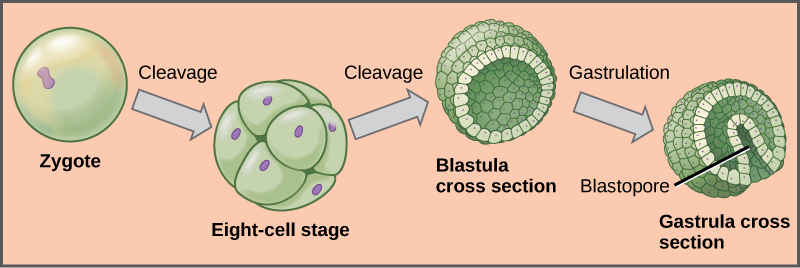
Beast development begins with cleavage, a series of mitotic prison cell divisions, of the zygote ((Figure)). Cleavage differs from somatic cell sectionalization in that the egg is subdivided by successive cleavages into smaller and smaller cells, with no actual cell growth. The cells resulting from subdivision of the material of the egg in this way are called blastomeres. Three cell divisions transform the single-celled zygote into an eight-celled structure. After further cell division and rearrangement of existing cells, a solid morula is formed, followed by a hollow structure called a blastula. The blastula is hollow only in invertebrates whose eggs accept relatively small-scale amounts of yolk. In very yolky eggs of vertebrates, the yolk remains undivided, with most cells forming an embryonic layer on the surface of the yolk (imagine a craven embryo growing over the egg's yolk), which serve as nutrient for the developing embryo.
Farther cell sectionalisation and cellular rearrangement leads to a process chosen gastrulation. Gastrulation results in ii important events: the formation of the primitive gut (archenteron) or digestive cavity, and the formation of the embryonic germ layers, equally we have discussed to a higher place. These germ layers are programmed to develop into certain tissue types, organs, and organ systems during a procedure chosen organogenesis. Diploblastic organisms accept ii germ layers, endoderm and ectoderm. Endoderm forms the wall of the digestive tract, and ectoderm covers the surface of the animate being. In triploblastic animals, a third layer forms: mesoderm, which differentiates into various structures between the ectoderm and endoderm, including the lining of the body cavity.
Evolution of a simple embryo. During embryonic evolution, the zygote undergoes a series of mitotic jail cell divisions, or cleavages, that subdivide the egg into smaller and smaller blastomeres. Note that the 8-cell stage and the blastula are about the same size as the original zygote. In many invertebrates, the blastula consists of a single layer of cells effectually a hollow space. During a process called gastrulation, the cells from the blastula movement inward on one side to class an inner crenel. This inner cavity becomes the primitive gut (archenteron) of the gastrula ("little gut") stage. The opening into this cavity is chosen the blastopore, and in some invertebrates it is destined to form the mouth.
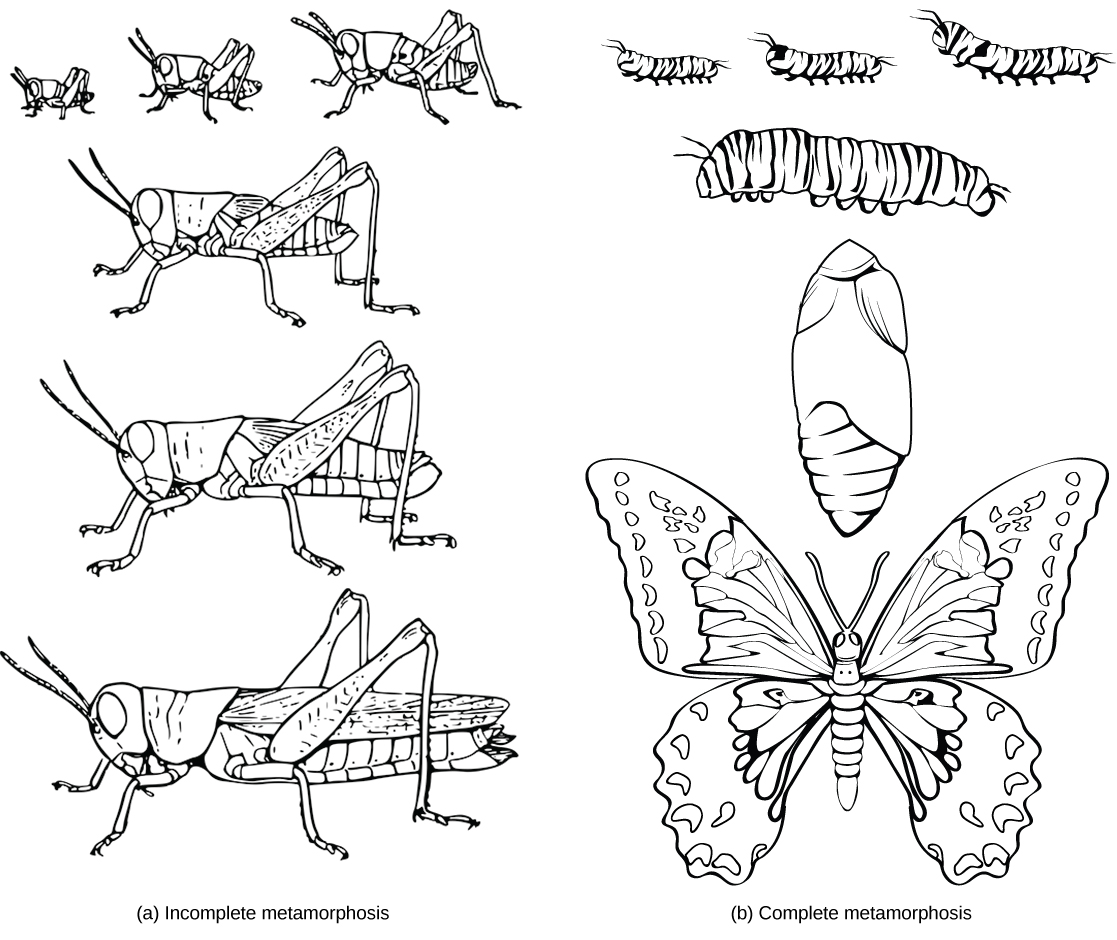
Some animals produce larval forms that are different from the adult. In insects with incomplete metamorphosis, such equally grasshoppers, the young resemble wingless adults, but gradually produce larger and larger wing buds during successive molts, until finally producing functional wings and sex organs during the last molt. Other animals, such equally some insects and echinoderms, undergo complete metamorphosis in which the embryo develops into one or more feeding larval stages that may differ profoundly in structure and function from the adult ((Figure)). The adult torso so develops from one or more regions of larval tissue. For animals with complete metamorphosis, the larva and the adult may take different diets, limiting competition for nutrient between them. Regardless of whether a species undergoes complete or incomplete metamorphosis, the series of developmental stages of the embryo remains largely the aforementioned for most members of the animal kingdom.
Insect metamorphosis. (a) The grasshopper undergoes incomplete metamorphosis. (b) The butterfly undergoes complete metamorphosis. (credit: S.Eastward. Snodgrass, USDA)
Link to Learning
Watch the post-obit video to encounter how human being embryonic development (after the blastula and gastrula stages of development) reflects development.
The Role of Homeobox (Hox) Genes in Animal Development
Since the early nineteenth century, scientists have observed that many animals, from the very simple to the complex, shared similar embryonic morphology and development. Surprisingly, a human embryo and a frog embryo, at a certain stage of embryonic development, look remarkably alike! For a long fourth dimension, scientists did non understand why so many creature species looked like during embryonic development but were very different as adults. They wondered what dictated the developmental direction that a fly, mouse, frog, or homo embryo would take. Near the cease of the twentieth century, a detail class of genes was discovered that had this very job. These genes that make up one's mind animal structure are called "homeotic genes," and they contain Deoxyribonucleic acid sequences called homeoboxes. Genes with homeoboxes encode poly peptide transcription factors. One grouping of animal genes containing homeobox sequences is specifically referred to as Hox genes. This cluster of genes is responsible for determining the general trunk programme, such every bit the number of body segments of an animal, the number and placement of appendages, and animal head-tail directionality. The outset Hox genes to be sequenced were those from the fruit wing (Drosophila melanogaster). A single Hox mutation in the fruit fly tin can effect in an actress pair of wings or even legs growing from the head in place of antennae (this is because antennae and legs are embryologic homologous structures and their appearance as antennae or legs is dictated by their origination within specific body segments of the head and thorax during development). At present, Hox genes are known from most all other animals besides.
While in that location are a swell many genes that play roles in the morphological development of an animal, including other homeobox-containing genes, what makes Hox genes and then powerful is that they serve as "master control genes" that can plough on or off big numbers of other genes. Hox genes do this by encoding transcription factors that command the expression of numerous other genes. Hox genes are homologous across the beast kingdom, that is, the genetic sequences of Hox genes and their positions on chromosomes are remarkably similar beyond almost animals because of their presence in a common ancestor, from worms to flies, mice, and humans ((Figure)). In addition, the guild of the genes reflects the anterior-posterior axis of the fauna's body. One of the contributions to increased beast body complexity is that Hox genes have undergone at least two and perhaps equally many every bit four duplication events during animal evolution, with the additional genes assuasive for more than complex body types to evolve. All vertebrates have four (or more) sets of Hox genes, while invertebrates have merely one fix.
Visual Connexion
Hox genes. Hox genes are highly conserved genes encoding transcription factors that determine the course of embryonic development in animals. In vertebrates, the genes have been duplicated into four clusters on different chromosomes: Hox-A, Hox-B, Hox-C, and Hox-D. Genes within these clusters are expressed in sure trunk segments at certain stages of evolution. Shown hither is the homology between Hox genes in mice and humans. Note how Hox cistron expression, every bit indicated with orange, pink, blue, and greenish shading, occurs in the aforementioned body segments in both the mouse and the human. While at to the lowest degree one copy of each Hox cistron is present in humans and other vertebrates, some Hox genes are missing in some chromosomal sets.
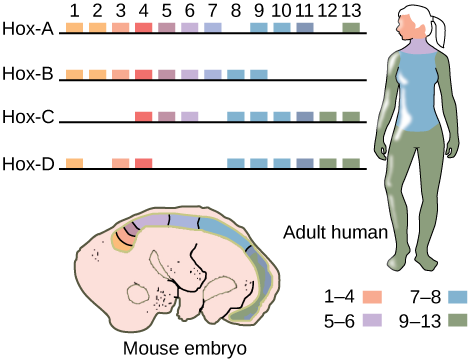
If a Hox xiii gene in a mouse was replaced with a Hox 1 gene, how might this alter animal development?
Two of the five clades within the animal kingdom practice non have Hox genes: the Ctenophora and the Porifera. In spite of the superficial similarities between the Cnidaria and the Ctenophora, the Cnidaria accept a number of Hox genes, but the Ctenophora have none. The absenteeism of Hox genes from the ctenophores has led to the suggestion that they might be "basal" animals, in spite of their tissue differentiation. Ironically, the Placozoa, which have only a few prison cell types, do take at to the lowest degree i Hox gene. The presence of a Hox gene in the Placozoa, in improver to similarities in the genomic organization of the Placozoa, Cnidaria and Bilateria, has led to the inclusion of the 3 groups in a "Parahoxozoa" clade. However, we should note that at this time the reclassification of the Beast Kingdom is still tentative and requires much more written report.
<!–<para>The animal might develop two heads and no tail.–>
Section Summary
Animals establish an incredibly various kingdom of organisms. Although animals range in complexity from simple body of water sponges to human beings, virtually members of the animal kingdom share sure features. Animals are eukaryotic, multicellular, heterotrophic organisms that ingest their food and usually develop into motile creatures with a fixed trunk plan. A major feature unique to the animal kingdom is the presence of differentiated tissues, such every bit nerve, musculus, and connective tissues, which are specialized to perform specific functions. Well-nigh animals undergo sexual reproduction, leading to a series of developmental embryonic stages that are relatively similar beyond the animal kingdom. A grade of transcriptional control genes called Hox genes directs the organization of the major animal body plans, and these genes are strongly homologous across the fauna kingdom.
Visual Connection Questions
(Figure) If a Hox 13 gene in a mouse was replaced with a Hox 1 factor, how might this alter fauna development?
(Figure) The creature might develop two heads and no tail.
Review Questions
Which of the post-obit is non a feature common to most animals?
- development into a stock-still body plan
- asexual reproduction
- specialized tissues
- heterotrophic nutrient sourcing
B
During embryonic development, unique jail cell layers develop into specific groups of tissues or organs during a stage called ________.
- the blastula phase
- the germ layer stage
- the gastrula stage
- the organogenesis stage
C
Which of the following phenotypes would nearly likely be the result of a Hox cistron mutation?
- aberrant torso length or acme
- ii different centre colors
- the contraction of a genetic illness
- two fewer appendages than normal
D
Critical Thinking Questions
Why might the evolution of specialized tissues exist of import for animal role and complexity?
The development of specialized tissues affords more circuitous animal anatomy and physiology because differentiated tissue types can perform unique functions and work together in tandem to allow the creature to perform more than functions. For example, specialized muscle tissue allows directed and efficient movement, and specialized nervous tissue allows for multiple sensory modalities besides as the ability to answer to various sensory information; these functions are non necessarily available to other nonanimal organisms.
Depict and give examples of how humans brandish all of the features common to the animal kingdom.
Humans are multicellular organisms. They also contain differentiated tissues, such equally epithelial, muscle, and nervous tissue, as well every bit specialized organs and organ systems. As heterotrophs, humans cannot produce their own nutrients and must obtain them by ingesting other organisms, such as plants, fungi, and animals. Humans undergo sexual reproduction, as well as the same embryonic developmental stages as other animals, which eventually lead to a stock-still and motile trunk program controlled in large part by Hox genes.
How have Hox genes contributed to the diversity of animal body plans?
Contradistinct expression of homeotic genes can lead to major changes in the morphology of the individual. Hox genes can affect the spatial arrangements of organs and body parts. If a Hox cistron was mutated or duplicated, it could affect where a leg might be on a fruit fly or how far apart a person's fingers are.
Glossary
- blastula
- xvi–32 cell stage of development of an animal embryo
- body program
- morphology or defining shape of an organism
- cleavage
- jail cell divisions subdividing a fertilized egg (zygote) to class a multicellular embryo
- gastrula
- stage of beast development characterized by the germination of the digestive cavity
- germ layer
- collection of cells formed during embryogenesis that will requite rise to future body tissues, more pronounced in vertebrate embryogenesis
- Hox gene
- (also, homeobox gene) chief command gene that tin turn on or off big numbers of other genes during embryogenesis
- organogenesis
- formation of organs in beast embryogenesis
Source: https://opentextbc.ca/biology2eopenstax/chapter/features-of-the-animal-kingdom/
Posted by: edgertongrous1984.blogspot.com
0 Response to "How Does The Animal Kingdom Get Nutrients"
Post a Comment