

Razer Opus review: The best $200 THX noise-canceling headphones right now
 Source: Daniel Rubino / Windows Central
Over-the-ear headphones with active noise-canceling (ANC) engineering science is becoming a highly competitive space these days. It'southward no wonder Razer, known for its highly-touted gaming peripherals, wants in on the activeness. Its new Opus THX-certified headphones are its first foray into mainstream accessories not aimed at gaming.
I've spent the terminal month with the Razer Opus and merely put they're excellent. The $200 ear cans are incredibly comfortable, simply the THX-tuned audio punches above its price range, giving Razer a seat at the table with the big players. Here is why.
Great audio, exceptional value
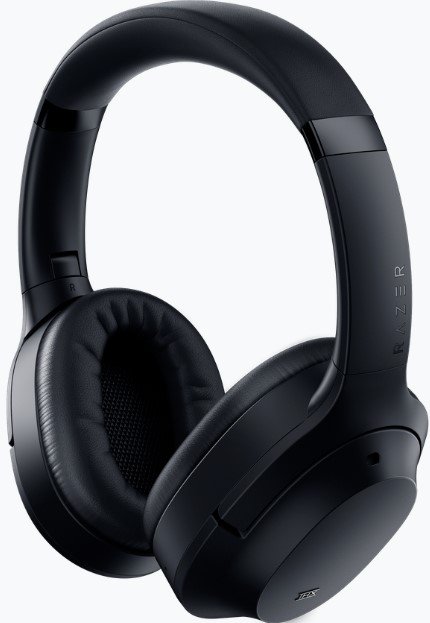
Razer Opus
$199
Bottom line: For $200, the audio quality, features, and battery life make the Razer Opus a highly competitive over-the-ear headset with active-noise-canceling ability. They're too extremely comfy.
Pros:
- Very comfortable.
- THX certification delivers
- First-class battery life
- Competitively priced
- Nice included accessories
Cons:
- Tin only accept i active-pairing
- No digital vocalisation assistant support
- Bluetooth 4.two
- Tin't customize EQ
Razer Opus Specs and what yous go
 Source: Daniel Rubino / Windows Key
Despite the lower toll signal, Razer has not cut corners with the Opus for features and specifications:
- Colors: Midnight blue or black
- Drivers: 2x 40mm dynamic
- Weight: 265g
- Frequency response: 20 Hz to 20 kHz
- Microphone: 4 for hybrid ANC, two for phonation chat
- Mode: circumaural (over-the-ear)
- Bombardment life: Up to 25 hours with ANC on
- Connectivity: Bluetooth 4.2 and iii.5mm
- Codecs: AAC & aptX, iv.2, A2DP, AVRCP, HFP
A few things stand out here. Regarding weight, the Opus is lighter than Surface Headphones 2 (290g), but a bit heavier than Bose's QC 35 IIs (235g). Battery life is not as loftier equally Sony's WH-1000XM3 (30 hours with ANC), but it is rated five hours longer than both Bose and Microsoft'due south Surface Headphones 2 (both 20 hours with ANC). Frequency response is average but proficient at twenty Hz (Bose doesn't list its frequency range, but assay pegs it around 10Hz).
Dissimilar the Bose, which are a few years quondam at present, the Razer Opus follows Sony and Microsoft with USB Type-C charging (including fast charge).
Bluetooth four.two is a bit of a bummer in 2022, but aptX codec back up is notable.
There are two colorways for the Opus, including midnight bluish (tested here) and black.
Razer also does not skimp on ANC. There are diverse ways to implement ANC in headphones, and Razer went for the more than expensive and constructive way: four mics (hybrid), with two on the outside (feedforward ANC) and ii on the inside (feedback ANC) of the ear cups.
The Razer Opus ship in an excellent hard-trounce example like Bose, Sony, and Microsoft. But unlike Microsoft'southward Surface Headphones, the Opus fold occupying smaller storage space. Bose and Sony nonetheless have smaller carrying cases, but it is not past a considerable amount.
Within, Razer supplies the typical and expected assortment of accessories, including:
- 3.5mm audio cable
- USB-C charging cable
- USB-A to USB-C adapter
- Airline headphone adapter
It'south rare to see them, including airline headphone adapter as many airplanes have switched to a more than standardized three.5mm one, but it's certainly a nice bonus here, especially at this price.
On the left earcup are the Type-C port, 3.5mm headphone jack, power/pair button, and a button for the racket canceling and ambience. Like other ANC headphones, users can press and agree the ambient button to amplify the groundwork sound in a room ("Quick Attention Mode"), making it ideal for someone to talk to yous or overhear the flight PA.
On the right earcup is a play/pause/skip button (middle) with volume up and down flanking it. The center button is slightly recessed, letting you easily control your music without looking.
The Opus will also motorcar-break and start when placed effectually your neck and returned to your head, respectively.
Razer Opus how are they?
 Source: Daniel Rubino / Windows Central
Curt have hither: these are amazingly comfortable headphones. The balance between the top pressure of the headband, which is padded moderately, and the ear cups is fantastic. I never had any sore spots, and compared to Sony, Bose, and Microsoft, these were the most comfortable for a prolonged elapsing.
Build quality is average and on par with the Bose QC 35 IIs. The Opus is made from plastic with cups that rotate 90 degrees in. Information technology would have been nicer if they were like the new Surface Headphones ii, which now rotate 180 degrees.
Audio quality with THX is outstanding. Razer, who technically owns THX, worked closely with its engineers to make sure the Opus meets the standards of THX both in hardware and sound quality. Technically, any headphone manufacturer can earn the THX headphone certification, but Razer is one of the first to do and then. Information technology's a rigorous programme that starts from prototyping the hardware up through testing and final certification. THX focuses on frequency response, baloney vs. output, and isolation of external noise.
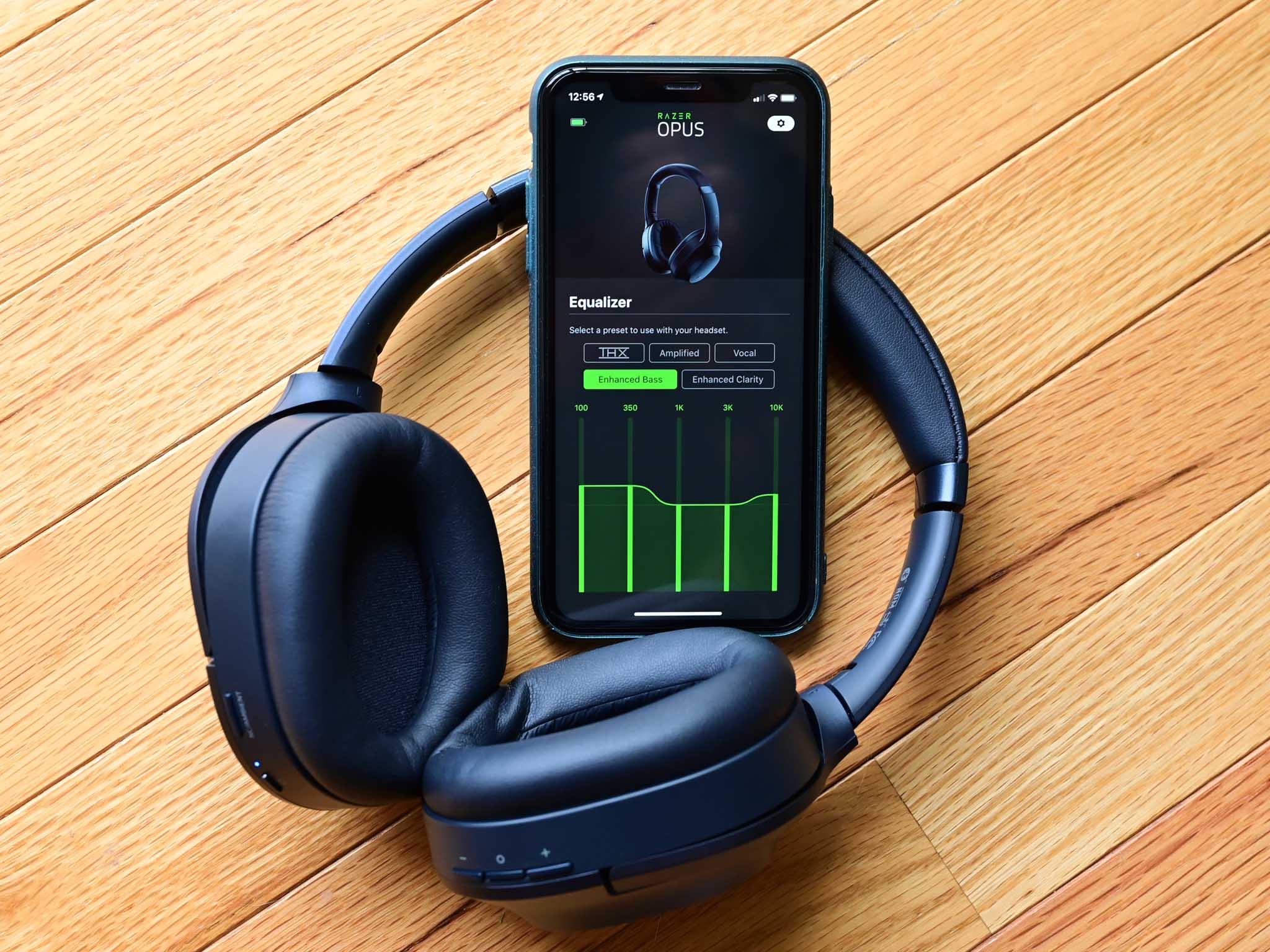
 The Razer Opus app for Android and iOS. Source: Daniel Rubino / Windows Central
To control the Opus, users tin download a specialized app, which lets you custom the sound, fix time out, and get firmware updates. The THX preset is one of five available, including amplified, vocal, enhanced bass, and enhanced clarity. While there is an EQ to visualize these changes, there is no way to customize it. All the same, because Bose doesn't even offer any such presets, this isn't a terrible thing.
Bombardment life is rated at 25 hours, and while I couldn't exam that in one sitting, I will comment that it seems in the ballpark with days of usage. Users can also charge with Blazon-C while using the Opus, including ANC engaged. The aforementioned applies when using 3.5mm headphone for audio so long as the Opus is powered.
ANC is also splendid. I tested using a Dolby Atmos surround organization while playing a few YouTube videos of ambient talking and background racket. The noise was attenuated as expected, and information technology even worked well with my typing on a mechanical keyboard where the sound was dampened (though not completely eliminated). All the same, there is one limitation in that y'all tin can't control the levels of ANC; information technology's either on or off.
 Source: Daniel Rubino / Windows Central
The lack of Bluetooth 5.0 is disappointing, but that standard tends to assistance headphones with battery life, something the Opus is not lacking. I also had no issues with connectivity. I could walk 35 feet from my phone and not experience any degradation in sound quality, even in a different room.
Unfortunately, the Opus cannot be actively paired to two devices, different Surface Headphones and Bose. While you tin have multiple pairings, users volition need to forcefulness disconnect from one device to connect to some other, similar to how Sony'southward WH-1000XM3 operates.
Finally, there is a notable absence of whatever phonation assistant ability with the Opus. Depending on how you feel about such things, this is either a disappointment or a shoulder shrug (information technology's the latter for me). I assume that the lack of any Google Assistant or Amazon Alexa "built-in" functionality helped proceed the cost down equally there are some licensing charges there that are ultimately pushed to consumers.
Razer Opus: Bottom line
 Source: Daniel Rubino / Windows Central
I accept quite a few premium noise-canceling headphones at my disposal these days. Each has pros and cons, and there is a detail subjective bias that is involved, especially considering they are all fantabulous at some level.
The expert news is the Razer Opus easily competes at this higher level with Bose, Sony, and Microsoft, which is impressive on a kickoff-generation headset. But actually, what makes the Razer stand out from the pack is its price: $200. That cost puts them at $150 less than Bose and Sony and is still $l cheaper than Microsoft's. That'due south hard to ignore, and it'southward not apparent to me why Bose or Sony's would be worth that extra money.
For that cost-savings, you lot become longer battery life and what I think are the most comfortable of the lot.
 Fifty to R, top to bottom: Razer Opus, Sony WH-1000XM3, Surface Headphones, Bose QC 35 Two. Source: Daniel Rubino / Windows Key
The audio is also first-class edging more on a crisp side compared to Surface Headphones ii. While Bose tends to excel in ANC, its actual sound quality for music has always lagged compared to Sony, and even Microsoft.
But beingness THX certified ways that the Opus doesn't over-do the bass (fifty-fifty when set to enhanced bass), which is how some listeners prefer to listen. That'southward not to say at that place isn't bass. I'd draw Opus as being rich and balanced.
The most pregnant potential drawbacks for Opus are the inability to multi-connect, older Bluetooth 4.2, and the lack of a voice assistant for your smartphone or PC. You as well cannot dynamically control ANC, unlike other premium headsets. But none of these are bargain killers when you balance off the impressive battery life, THX audio quality, effective noise-counterfoil, ability to fold, and a squeamish assortment of accessories in that difficult-shell example. The Opus looks swish besides, which is a prissy deviation from the typical Razer gamer aesthetic.
Overall, information technology'southward easy to recommend the Razer Opus, specially if you lot want to stretch your dollar.
THX and comfort

Razer Opus
Immense audio
Razer's mainstream Opus headphones evangelize excellent condolement, long-lasting battery, excellent ANC, with impressive audio quality all for a lot less than the competition making them like shooting fish in a barrel to recommend.
We may earn a commission for purchases using our links. Learn more.

For gamers by gamers
The all-time Razer keyboards for your gaming PC
Razer makes a lot of great keyboards, but there are some that rise above the residual. If you're going to buy a new Razer gaming keyboard, these are the ones to get.

Source: https://www.windowscentral.com/razer-opus-review
Posted by: edgertongrous1984.blogspot.com
0 Response to "Razer Opus review: The best $200 THX noise-canceling headphones right now"
Post a Comment